
There is a popular phrase that has been on my mind for a long time. The phrase connects many things in real-life situations. It is “In the kingdom of the blind, the one-eyed man is king”. This is instructive. What does this mean, and why does it resonate to date in real-life situations? This piece is a strategic one, and there is a need to read between the lines to connect with my argument. It is an attempt to put issues in proper perspective. My father once told me to ask for help whenever I need it. He emphasized that self-deception is the worst thing I could inflict on myself.
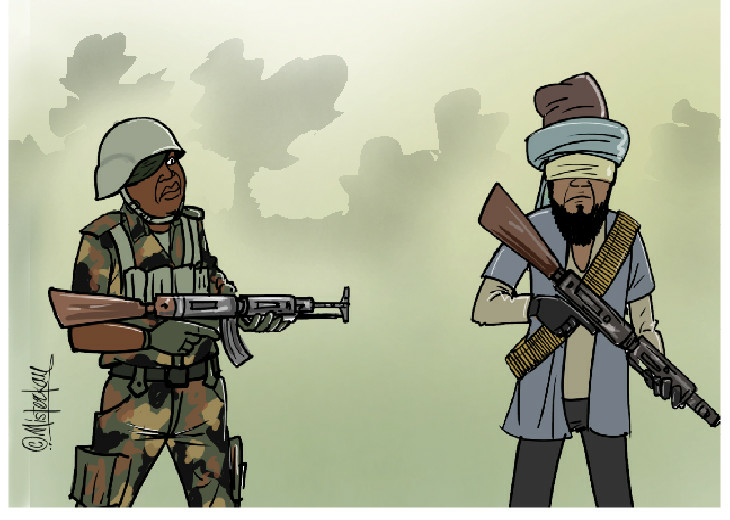
The country is facing security challenges. If wishes were horses, beggars would ride, and the Boko Haram/ISWAP menace would have been a thing of the past. But this is far from our reality, and we don’t need to deceive ourselves about this. We are in the era of asymmetric warfare. Asymmetric warfare is like reading a book upside down. It is an exercise in cognitive distortion. You have to manually decode every letter, fight your instincts, and piece together a meaning that is constantly trying to slip away. It also requires an extreme level of concentration. In the northeast, the line between combatants and civilians has been erased. This has made the enemy a “ghost” that inhabits the same social space as the victim.
The blind war
In asymmetric warfare, the “man with one eye is king” victory belongs to those with the vision to decode threats from a distance and address the threat in its “infancy” before it turns into “adulthood”. In a blind war situation, the party that can “see” just a little bit more than the other has an advantage. This was corroborated by Sun Tzu, the renowned Chinese military strategist, in his iconic work “The Art of War”. He postulated that the best way to win is not to fight. The interpretation is “out-thinking” and not “out-fighting”. Unfortunately, we have focused on out-fighting rather than out-thinking the adversaries. That is why we often hear things like the military dislodged Boko Haram insurgents from their strongholds, or the military repelled a Boko Haram attack. This is out-fighting, and it is not sustainable.
On the flip side, out-thinking is pre-empting the actions of the enemy and acting ahead of them. More like preventing them from carrying out their actions. The best way to win an asymmetric war is not to fight. It means attacking the enemy’s plans breaks it before they execute it, and the battle never happens.
Intelligence is sight
I have also followed the conversations around the presence of U.S soldiers in Nigeria. The debate has been around the concept of “boots on the ground” and “threat to our sovereignty”. The argument is not logical. We need to exercise some patience to understand the security pact with the United States. Let me put it plain. We need that “one eye” advantage by boosting our Intelligence, Surveillance and Reconnaissance (ISR) capabilities. This is the A-Z of the military pact. We must embrace our reality. We don’t have the ISR capabilities to defeat terrorism in Nigeria. This has been the missing link. Were we thinking American soldiers would be driving around Borno state with tanks and heavy artillery? Or were we thinking the American soldiers would replace our commanders and establish military bases in the North-east?
UNOSOM II
The last time the United States deployed “boots on the ground in Africa” was in 1994 in Somalia. The United Nations Operation in Somalia (UNOSOM II) has remained the ghost that haunts the Americans. It failed because the U.S troops fought blindly. They had “boots on the ground” but no “one eye”. At the time, drones and real-time ISR were in their infancy. The Americans suffered severe and horrific casualties. It was a slippery floor, and the United States has avoided that “slippery floor” in Africa for over 30 years. They won’t take such a risk in Nigeria now with the sophistication of their ISR capabilities.
The United States is a world power because of its ISR capabilities in warfare, and operates a Global Integrated ISR infrastructure. In my reckoning, by this pact, Nigeria is integrating into a high-tier intelligence network. This is the “one eye” that we need to make progress in the war against terrorism. We need a symmetric partnership to prosecute the Boko Haram/ISWAP asymmetric war. To fight an enemy that is hidden, you need a well-informed partner. It means the partner can give you information about your enemy that would prove useful.
Let me attempt to explain this using alternate history. A group of war experts are seated and monitoring the images and videos of an unmanned drone deployed in surveillance operations 200 kilometres away. The drone identified an ammunition storage dump of Boko Haram/ISWAP terrorists and destroyed it with zero human casualties. Two weeks later, troops of the 30 Task Force Brigade were ambushed in a remote village on their way to clearance operations, and several soldiers lost their lives. The first scenario is the “one eye” advantage. The second scenario is the “blind war” disadvantage. In warfare, you can’t defeat what you can’t see. It has never happened and won’t happen anytime soon. I stand to be quoted.
Chloroquine is bitter, but effective
My position is unambiguous. We need help. It is always a tough one and a bitter pill to swallow. I remember in my growing-up years, I dreaded chloroquine. It was bitter, but it cured malaria at the time. I could not say no to it. It was a medication that was recommended as a matter of necessity and survival. Even the thought of the discomforting itching side effect could not convince me otherwise. I still took the tablets. And was cured of malaria.
My argument is that if things are rearranged slightly as a result of this pact, it is not out of place. It is the price we have to pay to have the “one eye” advantage in addressing the security challenges in the country. And suffice to add that it is urgent. If eventually the end justifies the means, whose ox is gored? And who benefits? When your house is on fire, you don’t argue with the person with the fire extinguisher. Your priority is quenching the fire. If we desire to address the security situation in the country, even if the solution is bitter, we must swallow it. The chloroquine analogy buttresses this. It was a case of necessity and survival. We should not hesitate to seek help, especially when the picture is grim.
A caveat.
I deliberately chose not to comment on the unfolding geopolitical developments involving the United States, its allies, and its perceived foes. That omission was intentional, as the situation remains fluid and demands careful observation. There are also growing concerns about the prospect of Nigeria being drawn, whether directly or indirectly, into a global “tug‑of‑war”. This angle warrants deeper analysis, and I intend to explore it fully in my next article. I cannot pretend to be unaware of the possible implications. Indeed, interesting times lie ahead.
Ocheja, PhD, a military historian and creative writer, is an alumnus of the Nigerian Defence Academy.