
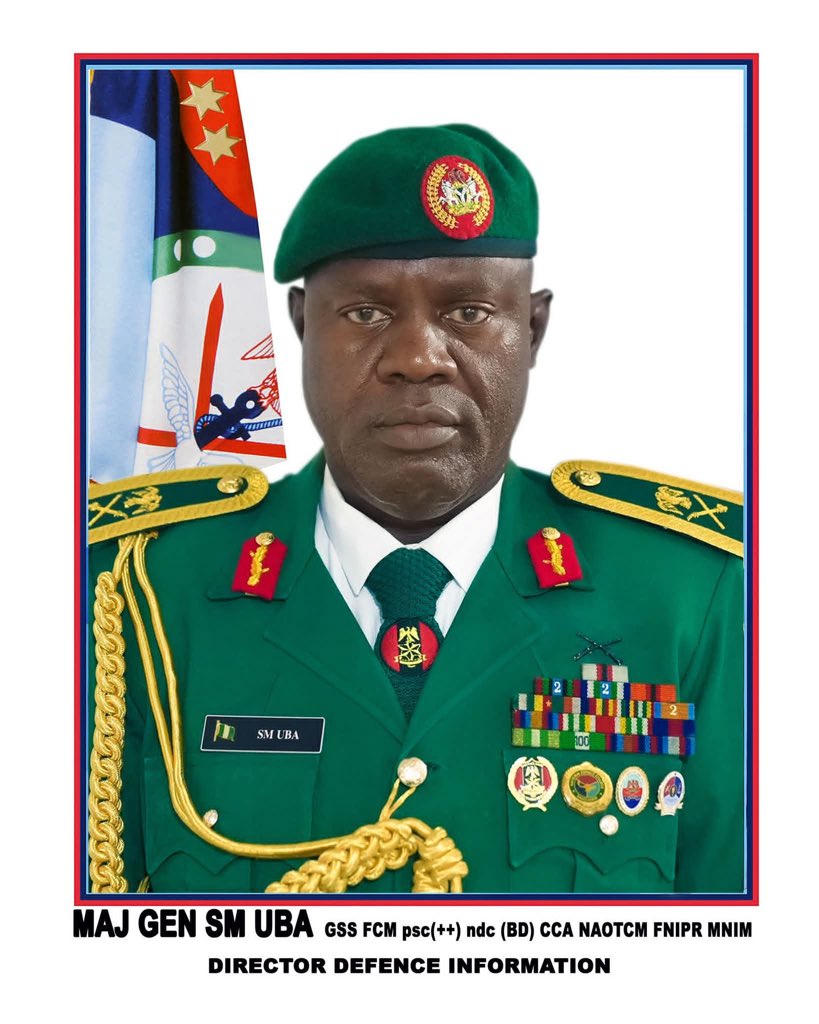
The Defence Headquarters has clarified that Nigeria’s growing military cooperation with the United States Army does not involve plans to establish a foreign military base in the country, stressing instead that the relationship is focused on training, intelligence sharing, and strengthening the operational capacity of the Nigerian Armed Forces.
The explanation was given by Major General Samuel M. Uba, Director of Defence Information, during a public discussion on a Twitter Space where he addressed questions surrounding the nature of the military partnership between Nigeria and the United States.
According to him, the defence cooperation between both countries is part of a broader international engagement framework aimed at enhancing Nigeria’s military professionalism and improving its ability to respond effectively to emerging security threats.
*Clarifying misconceptions*
Major General Uba said recent public discussions had generated speculation suggesting that the partnership might lead to the establishment of a United States military base in Nigeria. He stated clearly that such claims are inaccurate and do not reflect the realities of the bilateral defence relationship.
He explained that Nigeria’s collaboration with the United States is strictly based on military-to-military cooperation involving structured training programmes, intelligence exchange, and strategic operational support.
“The cooperation does not translate into establishing a foreign military base in Nigeria,” he said. “Our engagements are centred on professional training, operational capacity building, and intelligence sharing that helps strengthen our national security framework.”
He added that the Nigerian military remains firmly under the command and authority of the Nigerian government, stressing that all forms of international cooperation are conducted with strict respect for Nigeria’s sovereignty and national interest.
*Focus on strengthening military capacity*
Security analysts often note that modern military partnerships increasingly focus on knowledge exchange rather than permanent troop deployments. In this context, Major General Uba explained that Nigeria benefits from global exposure through training programmes that introduce its officers and personnel to evolving military technologies and operational strategies.
He said these programmes help Nigerian troops learn modern approaches to counterterrorism operations, surveillance systems, cyber security, and coordinated intelligence operations.
Joint training exercises between Nigerian and American military personnel have also provided opportunities for soldiers to operate in simulated combat scenarios, allowing them to improve their readiness for real-world missions.
According to him, these engagements strengthen tactical planning, coordination among military units, and the use of advanced operational tools.
“The goal is to equip our personnel with global best practices that improve efficiency in safeguarding the nation,” he explained.
*Intelligence sharing and security cooperation*
Another major component of the partnership is intelligence collaboration. Major General Uba noted that intelligence sharing between Nigeria and its international partners helps security agencies detect threats earlier and respond more effectively.
He said such cooperation has become particularly important in an era where security threats increasingly cross national borders.
Groups involved in terrorism, arms trafficking, cybercrime, and other transnational criminal activities often operate across several countries, making international collaboration essential.
Through intelligence exchange mechanisms, Nigerian security agencies are able to access valuable information that helps track the movement of criminal networks, disrupt planned attacks, and strengthen national security operations.
Major General Uba stressed that intelligence sharing operates within defined legal frameworks and mutual agreements between both countries.
*Nigeria’s broader defence diplomacy*
The Defence Headquarters spokesman also pointed out that Nigeria’s cooperation with the United States is not an isolated arrangement.
He said Nigeria maintains defence partnerships with several countries around the world as part of its defence diplomacy strategy.
These partnerships allow Nigerian officers to participate in international training institutions, attend military courses abroad, and take part in multinational security exercises.
According to him, such engagements are designed to improve the professional competence of Nigerian military personnel while building stronger diplomatic relationships with allied nations.
Countries across Europe, Asia, and Africa maintain similar defence cooperation agreements with Nigeria, often focusing on specific areas such as maritime security, peacekeeping operations, and counterterrorism training.
Through these collaborations, the Nigerian military gains exposure to diverse operational environments and strategic planning methods.
*Addressing Nigeria’s security challenges*
Nigeria currently faces multiple security challenges that require coordinated responses from its military and other security agencies.
These include insurgency in the northeast, banditry in parts of the northwest, kidnapping for ransom in several regions, and criminal networks involved in arms trafficking and illegal mining.
Major General Uba explained that international military partnerships help the Nigerian Armed Forces adapt to the evolving nature of these threats.
For instance, counterterrorism operations require a combination of surveillance technology, intelligence gathering, and coordinated ground operations.
Training programmes with international partners help Nigerian forces improve their ability to conduct such complex operations.
He noted that joint exercises also provide opportunities for Nigerian troops to refine operational planning, command structures, and rapid response strategies.
*Safeguarding sovereignty*
During the discussion, participants raised questions about national sovereignty and whether foreign military partnerships could compromise Nigeria’s independence in security decision making.
Responding to these concerns, Major General Uba reassured the public that Nigeria retains full control over its defence policies and operational decisions.
He emphasized that all military collaborations are governed by bilateral agreements that clearly define the scope of cooperation.
“No foreign country controls our military operations,” he said. “All engagements are structured to support Nigeria’s security priorities while maintaining complete respect for our sovereignty.”
He added that Nigeria’s defence leadership remains committed to ensuring that international partnerships serve the country’s national interest.
*Role of training institutions*
Another aspect of the cooperation involves exchanges between defence institutions in both countries.
Officers from the Nigerian Armed Forces occasionally attend courses at American military institutions, while trainers and instructors from partner countries sometimes participate in professional development programmes in Nigeria.
Such exchanges allow military professionals to share operational experiences, research insights, and strategic planning techniques.
These interactions also foster long-term professional relationships between military officers, which can enhance coordination during multinational peacekeeping operations.
Nigeria has historically played a leading role in peacekeeping missions across Africa under the auspices of regional and international organizations.
Training collaborations therefore help prepare Nigerian troops for deployment in complex peacekeeping environments.
*The importance of global collaboration*
Security experts participating in the Twitter Space discussion agreed that international cooperation has become a necessity in modern defence strategy.
They noted that global security challenges such as terrorism, cyber threats, and organized crime networks cannot be effectively addressed by any single country acting alone.
Collaborative intelligence systems, joint military exercises, and shared training platforms allow nations to respond more quickly to emerging threats.
Participants also observed that partnerships like the one between Nigeria and the United States can help strengthen regional security in West Africa.
By improving Nigeria’s defence capabilities, they said, the country is better positioned to contribute to stability across the region.
*Public transparency and dialogue*
The discussion also highlighted the growing importance of transparency in security communication.
By engaging citizens through digital platforms like Twitter Spaces, defence authorities are able to address public concerns directly and clarify issues that might otherwise generate misinformation.
Major General Uba said the Defence Headquarters values public engagement because informed citizens are an important part of national security awareness.
He encouraged Nigerians to rely on official sources for information regarding defence matters.
*Looking ahead*
While reaffirming that there are no plans to establish a foreign military base in Nigeria, the Defence Headquarters spokesman said Nigeria will continue to engage with international partners to strengthen its defence capabilities.
He explained that military cooperation will remain focused on improving operational efficiency, enhancing intelligence networks, and equipping the Nigerian Armed Forces to respond effectively to modern security threats.
Such partnerships, he noted, are a common feature of contemporary international relations and are essential in a rapidly changing security environment.
As Nigeria continues to confront complex security challenges, strategic collaboration with trusted partners is expected to remain a key component of the country’s defence strategy.
Major General Uba concluded by reiterating that the central objective of Nigeria’s international military engagements is to build a more capable, professional, and technologically advanced armed force that can protect the nation and contribute to regional peace and stability.
For many observers, the clarification offered during the public discussion underscores an important point. Military cooperation does not necessarily mean foreign control or the presence of overseas bases. In most cases, it simply reflects the need for nations to learn from each other and work together in addressing shared security concerns.
As Nigeria deepens its defence diplomacy, officials say the guiding principle will continue to be national interest, sovereignty, and the long-term goal of securing the country against evolving threats.